Ten Years After; the Same Question
Back in 2015 we wrote a short piece asking, “What the heck does R-I-M stand for?” The answer then was Rapid Implementation Methodology: a way of putting business software in place that starts from templates and best practice rather than a blank page.
The question still matters, because the old pattern still repeats. Every requirement becomes a customization, every customization adds hours, and the bill arrives long after the decisions that drove it. A decade later, the tools have moved on to Dynamics 365 Business Central (and Finance & Operations), but the principle has not.
Cost follows distance from best practice, and the client should be the one deciding how far to go.
Meet the Refreshed RIMETER
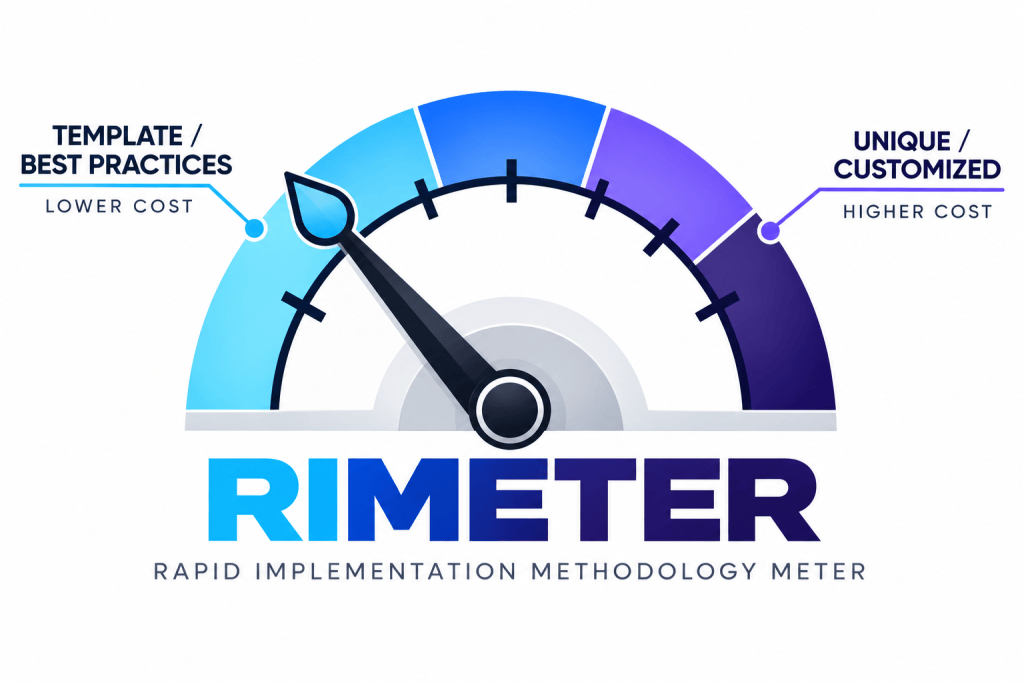
RIMETER is short for Rapid Implementation Methodology Meter. Picture a simple gauge. At one end sits Template: a proven, best-practice system, set up quickly and upgraded easily. At the other end sits Unique: a system shaped around every habit and exception the business has ever had. The scale between them is measured in hours.
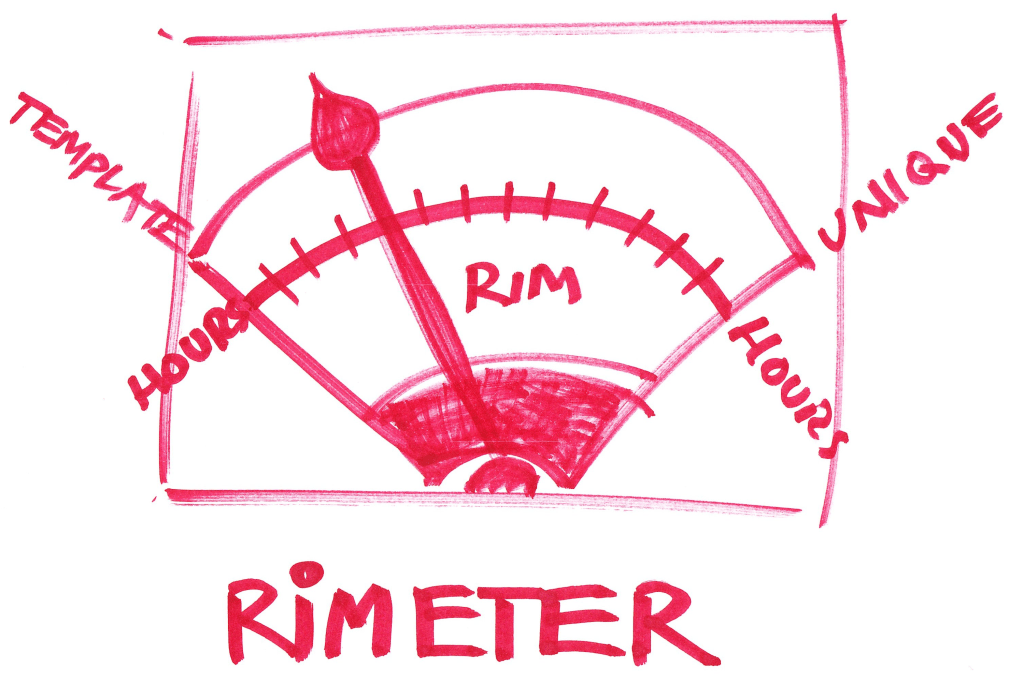
Every step along the scale toward Unique adds hours, not only in the first build but in every upgrade that follows. Some of those moves are worth it. A real competitive edge deserves to be built in. Many are not. They are simply the way things were done in the old system, carried forward at a price.
The point of the RIMETER is not to keep every project reading Template. It is to make each step along the scale visible, priced and deliberate. You decide where your project reads on the meter, so you control the cost.
The Formula Behind the Meter
The RIMETER does its work inside our Rapid Methodology Formula, a faster route through the Solution Matrix methodology for Business Central. It runs in three steps, and each one has a job to do with the reading.
- FoRM IT. We start from a proven Business Central template, refined over years of implementations. Your data comes in, the essentials are set up, and the business fits into a form that already works. Your project starts out reading as close to Template as your business allows.
- ConfiRM IT. Trust, then verify. You run the system on your own data and work through your real processes before go-live. What fits, you approve. What doesn’t, we discuss openly, and every request that moves the reading toward Unique is priced in hours.
- PerfoRM IT. Going live is the beginning, not the end. After go-live we refine and streamline, and we look for customizations that no longer earn their keep. Where we can, we bring the reading back toward Template.
FoRM IT and ConfiRM IT carry you through Make IT to Live IT, Phases 4 to 7. PerfoRM IT lives in Optimize IT and Evolve IT, Phases 9 and 10, which is where a relationship keeps a system from drifting.
Check the RIMETER Before You Commit
A gauge is only useful if you know where it reads today. That is the role of our Three Tools, and each one tells you something different about the reading.
- Real-IT Check. A free, no-obligation review and an honest read on where your systems stand. It shows how far your current setup has already drifted from Template, and whether the Formula is a sensible fit.
- Aud-IT Review. A fixed-fee deep dive into setups, configurations, data, integrations and the financial foundation. For an inherited or troubled system, it maps every customization and what each one costs to keep. You keep the documented findings, whatever you decide.
- Proof-IT First. A Proof-of-Fit prototype built to look and feel like your business. It lets you see the template working with your own processes before you commit, so the reading moves toward Unique only where it truly needs to.
None of the three obliges you to go further. Each one simply means the first real decision is made on facts, not on hope.

Who the RIMETER Is For
The RIMETER was drawn for two kinds of business, and both are more common than they appear.
The first is the smaller company ready for a real system. Perhaps you have outgrown what you have, or your current system is holding you back. You want best practice, and you do not want a long custom project to get it. The Formula gives you a proven starting point and a clear view of what each exception would cost.
The second is the rescue. The system was here when you arrived, or it’s running, but it isn’t working. Years of customization have pushed the reading far toward Unique, and every upgrade hurts. Here the RIMETER works in reverse: we find what can return to Template, and you decide what stays.
In both cases the conversation is the same one we have been having since 2015. Tell us where you want your project to read, at Template, at Unique or somewhere between, and we will show you what it takes to get there.
Take a RIMETER Reading
The first step costs nothing. A Real-IT Check gives you an honest read on where your system stands today and where the RIMETER would place it. From there, you decide what comes next.


Leave a Reply